People Aren't Searching Anymore. They're Asking.
Published April 22, 2026
Justin Jackson recently shared that 50% of trials on Transistor now come from LLMs. A year ago, it was 10-15%. Think about that. That is a massive jump in a year. And think about the fact that buyers coming from LLMs have more purchase intent as well. So not only are more customers coming from LLMs, they are more likely to buy too.
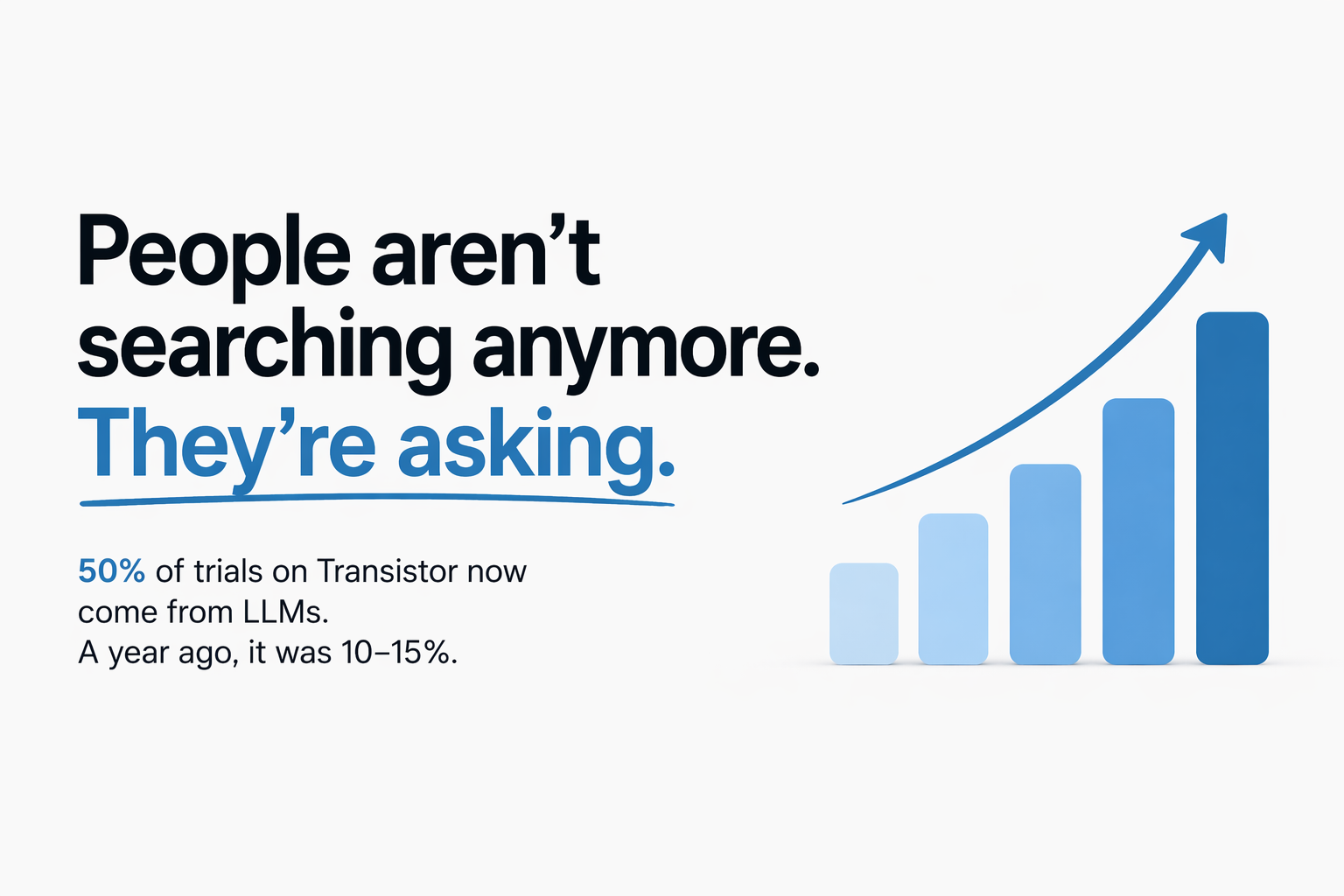
The way that people choose products is fundamentally changing. And we're in the wild wild west of AI search. It is still early days.
You've been so busy focusing on Google rankings, paid ads, cold outreach, and social distribution that you're sleeping on the best new way to find customers.
People aren't searching anymore. They're asking. And it's no longer about keywords, pages, rankings, or a ton of AI slop blog posts pumped with keywords. It's all about answers, citations, and trust.
What’s even more important is that these users don’t just convert... They come in with significantly higher intent, because they’re not browsing ten blue links or casually comparing options, they’re asking a direct question and expecting a direct answer about what they should use or buy.
There is no page one anymore
When a potential customer asks ChatGPT or Perplexity, "What's the best tool for X?" there is no page one of Google results. There is only what the model knows, what it has seen repeatedly, and what it trusts enough to recommend.
Your product suddenly has to show up consistently in Reddit threads, listicles, comparisons, blog posts, discussions, and more. And most companies are now invisible when a customer asks what product they should buy.
And this is the part that should make most companies uncomfortable, because right now, the majority of teams have no visibility in this. They don’t know what prompts their potential customers are actually using, they don’t know whether they show up in those answers, and they don’t know why a competitor is being recommended instead of them, so they fall back to what they understand, which is publishing more content, adding more keywords, and trying to improve rankings.
And suddenly... This isn’t a volume game where you blast out a bunch of blog posts to increase your chances of being the answer, it’s a perception game where consistent association with a specific use case is what determines whether you exist in the answer at all.
Why companies stay invisible
They don't know what prompts people are using. They don't know if they're showing up in answers. They don't know why competitors are showing up instead of them. So they write more and more content. They try to do more SEO. And so on and so forth.
The problem isn't solvable manually. If AI is the new big distribution layer with high buyer intent, you need to know three things:
- Where do you show up in ChatGPT, Claude, or Perplexity?
- Where are you missing?
- What should you do to show up in ChatGPT?
That's why I'm building Kelsey
Kelsey runs real, buyer-style prompts and shows you:
- The answers AI generates
- Whether your company is showing or not
- Where competitors are winning
- Exactly what you need to create to show up
What Kelsey does is run real, buyer-style prompts and show you the answers that models generate, whether your product is included, where competitors are showing up instead, and most importantly, what specific gaps exist between how you think you’re positioned and how you are actually perceived.
Because once you can see the gaps that you are missing, you can start to fix them.
This is the next growth channel. And early movers can win. We're still in that early window. If 50% of trials are already coming from LLMs for some companies, this isn't optional.