2026 Guide
Best Tools to Track ChatGPT Mentions
Compare the best AI visibility tools for tracking ChatGPT mentions, competitor recommendations, citations, and what to fix next.
Published July 4, 2026 · Last updated July 27, 2026
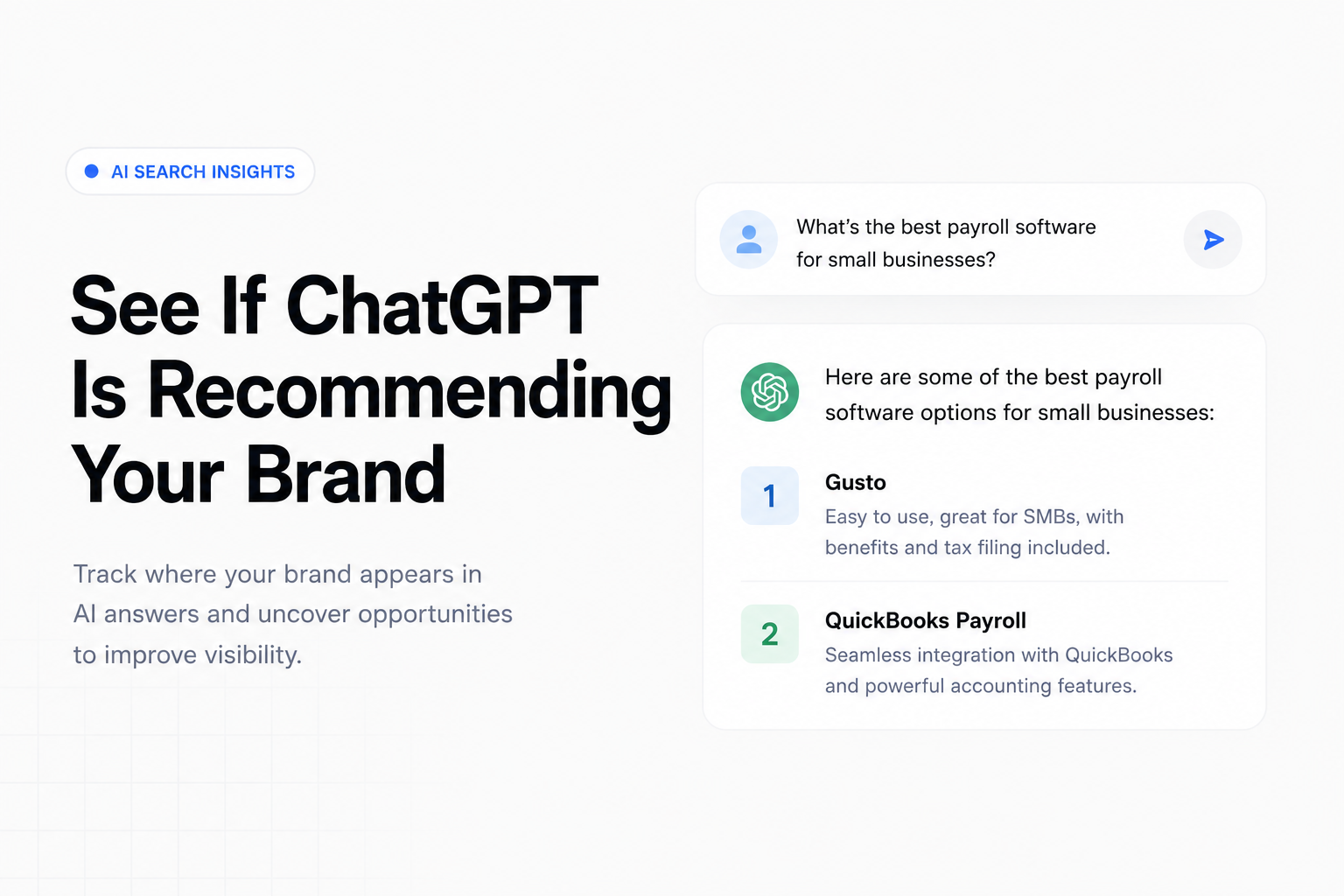
ChatGPT does not offer a built-in way to track brand mentions. The practical approach is to use AI visibility tools that show whether your brand is mentioned or recommended, which competitors appear instead, which sources are surfaced, and how those answers change over time.
Buyers are asking ChatGPT buying questions before they ever visit your site. If ChatGPT recommends three competitors and leaves you out, that is not just a brand awareness problem. It is a demand problem.
Below are seven tools worth comparing, plus a simple workflow for tracking mentions and turning misses into content actions. If you want a more action-focused workflow, Kelsey is built around lost buyer prompts and next steps.
In this guide we’ll cover
Key takeaways
- ChatGPT does not give brands a native dashboard for mention tracking, so teams use AI visibility or brand-monitoring tools.
- The most useful tools track prompts, brand mentions, competitor recommendations, citations or sources, and answer context.
- Monitoring is only the first step. The real value comes from turning missed recommendations into content actions.
- Kelsey is built for teams that want to find lost buyer prompts and decide what to create or improve next.
- Broader platforms can still be useful for SEO, CRM, social listening, or enterprise brand visibility, depending on your existing workflow.
Why ChatGPT mentions matter
Buyers are not only searching Google anymore. They are asking ChatGPT questions like:
- “What is the best project management tool for a remote team?”
- “What are the best alternatives to HubSpot?”
- “What software should I use for customer onboarding?”
- “What are the top tools for AI SEO?”
- “What is the best platform for a small marketing team?”
Those are buying questions. If ChatGPT recommends competitors but not you, buyers may form their shortlist before they ever visit your website, compare your pricing, or talk to your team.
That is why more companies are starting to track ChatGPT mentions the same way they used to track keyword rankings. The question is no longer only, “Do we rank on Google?” It is also, “When buyers ask AI for recommendations in our category, are we included?”
What are AI visibility tools for ChatGPT recommendations?
AI visibility tools track whether your brand is mentioned or recommended when buyers ask ChatGPT, Perplexity, Gemini, and other AI search systems category and vendor questions. In practical terms, they help teams find missed prompts, competitor recommendations, citations, and the content gaps behind them.
This is different from traditional SEO rank tracking. SEO rank tracking shows where pages appear in search results. ChatGPT recommendation tracking shows whether your brand is included in AI-generated buying recommendations.
The core signals to look for are:
- Whether your brand is mentioned
- Whether your brand is recommended
- Which competitors are recommended instead
- Which citations, sources, or answer context appear
- Which prompts are connected across a larger buyer journey
- What content to create or improve next
How to track brand mentions in ChatGPT answers
To track brand mentions in ChatGPT answers, define the buyer prompts that matter, run those prompts on a recurring cadence, record whether your brand is mentioned or recommended, compare which competitors appear instead, review the sources behind each result, and turn misses into content work. A weekly review works well because it turns monitoring into an operating rhythm, not a one-time audit.
Step 1: Define the buyer prompts that matter
Start with the questions your buyers actually ask when they are shortlisting tools. Focus on category prompts, alternatives prompts, use-case prompts, and competitor comparison prompts. Avoid vanity prompts that no real buyer would ask.
Good examples look like “best tools for [job to be done],” “best alternatives to [competitor],” or “best [category] software for [team or use case].” Write these down as a shared prompt list so your whole team is tracking the same questions over time.
Step 2: Run the prompts on a recurring cadence
ChatGPT answers are not fixed. They can change as sources, content, and model behavior change. Run your prompt set weekly or biweekly so you can spot shifts early instead of relying on a one-off audit.
You can do this manually at first, but the process gets hard to maintain once you are tracking more than a handful of prompts across ChatGPT, Perplexity, and Gemini. That is usually when a dedicated AI visibility tool becomes useful.
Step 3: Check whether your brand is mentioned or recommended
For each prompt, record whether your brand appears, whether it is recommended, and where it appears relative to competitors. The most useful tracking does not stop at mention rate. It also captures whether ChatGPT is building a shortlist that includes your competitors and leaves you out.
Step 4: Review citations, sources, and answer context
Citation and source visibility help explain why an AI answer looks the way it does. If ChatGPT cites a list, review page, competitor page, or category guide where you do not appear, your next action may be different from a prompt where the model simply misunderstands your positioning.
Look for the source mix behind the answer, including third-party lists, category pages, comparison pages, review pages, and your own site. That context tells you whether the miss is an on-site content problem, an off-site presence problem, or both.
Step 5: Turn misses into content actions
Monitoring is useful, but execution is where the value comes from. Connect each missed recommendation to a concrete content task:
- Create a comparison page when ChatGPT recommends a competitor for best-tools or alternatives prompts
- Add a use-case page when buyers ask about a specific team, industry, or workflow
- Improve a category explanation when AI systems misunderstand what your product does
- Add FAQs when buyer questions are recurring but not answered clearly on your site
- Update pages that should be cited but are missing key context
Quick comparison
The best tools to track ChatGPT mentions, at a glance.
| Tool | Best for | What you get |
|---|---|---|
| Kelsey | B2B SaaS teams that want lost prompts and clear actions | Prompt tracking, competitor mentions, citations, and next-step content actions |
| HubSpot AEO | Teams already living in HubSpot | AI search work connected to CRM, campaigns, and content ops |
| Semrush | SEO teams already using Semrush | AI search mentions alongside keyword and competitor research |
| Peec AI | Marketing teams focused on AI search analytics | Brand performance, competitor presence, and sources across AI platforms |
| Profound | Larger brands and enterprise marketing teams | Brand representation, citations, sentiment, and competitive context |
| Otterly AI | Teams that want prompt monitoring and alerts | Prompt responses, brand mentions, citations, and changes over time |
| AthenaHQ | Enterprise teams investing in AEO or GEO | Brand presence, trust signals, and actions that may improve AI answers |
Some teams also evaluate broader brand-monitoring platforms such as Brandwatch, Meltwater, Mention, Talkwalker, and Sprout Social when the main need is large-scale mention monitoring across text sources. That is different from an action-oriented AI visibility workflow, which connects missed ChatGPT prompts to the pages your team should create next.
7 tools to track ChatGPT mentions
1. Kelsey
Best for B2B SaaS teams that want lost prompts and clear next steps
Kelsey is built for teams that do not just want to know whether they were mentioned. They want to know which buyer prompts they are losing, which competitors are being recommended instead, and what they should do about it.
Tracking ChatGPT mentions by itself can become another dashboard people forget to check. A mention score is useful, but it is not enough if your team still has to manually figure out why ChatGPT chose a competitor, which page is missing, or which answer your site needs to make clearer.
Kelsey is especially useful for B2B SaaS companies because the prompts are tied to real buyer questions, not generic vanity prompts. For each prompt, the goal is to understand the recommendation path: Did ChatGPT mention you? Did it recommend a competitor? Did it cite a source you do not appear on? Is your site missing a comparison page, FAQ, use-case page, or clearer category explanation?
That is the difference between tracking and improving. If you want to see the buyer prompts where competitors are recommended instead of you, run a free scan. You can also compare Kelsey vs OtterlyAI or explore Kelsey for SaaS companies.
2. HubSpot AEO
Best for HubSpot customers that want AEO inside their marketing stack
HubSpot AEO is a natural fit for teams that already run marketing inside HubSpot and want AI search work connected to CRM, campaigns, and content workflows.
The biggest advantage is context. If customer data, content, and campaigns already live in HubSpot, AEO becomes less of a separate tool and more of an extension of your existing marketing operation. The tradeoff is that HubSpot may make the most sense when you are already committed to that ecosystem. If your main goal is specifically to find lost buyer prompts and decide what pages to create, you may want a more focused tool alongside or instead of a broader marketing platform.
3. Semrush
Best for SEO teams already using Semrush
Semrush is a strong option for SEO teams that want to add AI search tracking to an existing search workflow. Many teams already use Semrush for keyword research, competitor analysis, content planning, and SEO reporting, so adding AI search tracking inside the same ecosystem can make sense.
Semrush fits well if your team thinks about ChatGPT mentions as part of a broader search strategy. The tradeoff is that broad SEO platforms can feel heavier than a focused ChatGPT mention tracking workflow. If you want a dedicated view of which buyer prompts recommend competitors instead of you, and what content to ship next, you may want something more specialized.
4. Peec AI
Best for marketing teams focused on AI search analytics
Peec AI helps marketing teams analyze brand performance across AI search platforms, including ChatGPT, Perplexity, and Gemini. It is a good fit for teams that want a clear view of how their brand is performing, how competitors appear, and where AI systems are pulling information from.
The tradeoff is that analytics still need to turn into decisions. Tracking presence is helpful, but the real value comes when your team can connect that data to a clear weekly content or optimization plan. Compare: Kelsey vs Peec AI.
5. Profound
Best for enterprise brands and larger marketing teams
Profound is positioned for brands that want to understand and improve how they appear in AI-generated answers. It is a strong fit for larger marketing teams that care about brand representation, citations, sentiment, and competitive presence across AI search.
Profound is less about a lightweight check-a-few-prompts workflow and more about understanding how your brand is represented at scale. If you are a smaller B2B SaaS company trying to find the exact prompts where ChatGPT recommends competitors, you may want a narrower and more action-driven workflow first. Compare: Kelsey vs Profound.
6. Otterly AI
Best for teams that want prompt monitoring and alerts
Otterly AI is built around monitoring brand mentions, website citations, and prompts across AI search platforms. Instead of manually asking the same questions every week, teams can define prompts, monitor responses, and see how mentions shift over time.
Otterly may be a good fit if your team wants a straightforward monitoring setup. The tradeoff is that monitoring is only one part of the work. Once you know a competitor is being mentioned instead of you, your team still needs to decide what to publish, update, or promote. Compare: Kelsey vs Otterly AI.
7. AthenaHQ
Best for enterprise teams investing in AEO or GEO
AthenaHQ is positioned around helping companies become the brand AI trusts and the answer AI gives. It may appeal to teams that want AI visibility work to include brand positioning, answer presence, and actions that may improve how AI systems understand the company.
If your immediate need is to find the specific buyer prompts where ChatGPT recommends competitors instead of you, a more focused lost-prompt workflow may be easier to operationalize.
How to choose the right tool
Choose a monitoring tool if you only need alerts. Choose an action-oriented tool if you need content recommendations too.
- Choose a monitoring-first tool if your priority is recurring checks, alerts, and reporting.
- Choose a broader SEO stack if your team wants AI search visibility connected to keyword, competitor, and content research.
- Choose an enterprise visibility platform if your company needs brand representation, citations, sentiment, and executive-level reporting.
- Choose an action-oriented prompt-tracking tool if your team wants to find lost buyer prompts and decide what to create or improve next.
The most important criteria to compare are prompt-level ChatGPT recommendation tracking, competitor recommendations, connected prompt coverage across related questions, and fit with your existing team and stack.
The biggest mistake: tracking without acting
The biggest mistake is treating ChatGPT mention tracking as a dashboard-only exercise. It is useful to know whether your brand is mentioned. It is more useful to know why a competitor was recommended, which source shaped the answer, and what page your team should create or improve next.
| Missed pattern | What it may mean | Content action |
|---|---|---|
| Competitor appears in best-tools prompts and you do not | Category positioning may not be clear enough | Create or improve a category page or best-tools comparison |
| Competitor appears in alternatives prompts | Your site may not support the comparison buyers are making | Create a comparison or alternatives page |
| ChatGPT cites third-party lists where you are absent | The model may be relying on sources that do not include you | Improve off-site presence and update owned category pages |
| ChatGPT misunderstands who your product is for | Positioning may be too vague or inconsistent | Add clearer audience, use-case, and FAQ language |
| You are missing across many connected prompts | The gap is probably structural, not isolated | Prioritize a content cluster, not a one-off post |
Which tool should you choose?
- Kelsey if you want a focused way to find buyer prompts where competitors are recommended instead of you
- HubSpot AEO if your team already works heavily inside HubSpot
- Semrush if AI search tracking should live inside your existing SEO workflow
- Peec AI if you want AI search analytics across major platforms
- Profound if you need enterprise-level brand representation and sentiment reporting
- Otterly AI if you primarily want recurring prompt monitoring and alerts
- AthenaHQ if your organization is investing broadly in AEO or GEO
The right tool depends on the job you need done. If the job is simply monitoring, choose the platform that fits your reporting workflow. If the job is improving whether ChatGPT recommends you, choose a tool that connects visibility gaps to content actions.
Why Kelsey is different
Kelsey is built around actions and next steps, not a fake AI visibility score. The product is focused on the gap between monitoring and execution: find lost buyer prompts, understand which competitors are being recommended instead, see the citations influencing the answer, and decide what content to create or improve next.
That makes Kelsey a strong fit for B2B SaaS teams that want ChatGPT mention tracking to become a weekly growth workflow, not another dashboard.
FAQ
How do I track brand mentions in ChatGPT answers?
Use an AI visibility or brand-monitoring tool that can run prompts over time and capture whether your brand is mentioned, which competitors are recommended instead, and what sources are surfaced. Review those patterns weekly so you can update content based on the miss.
What are the best AI visibility tools for tracking brand recommendations in ChatGPT?
The best tools are the ones that show whether your brand is mentioned or recommended, which competitors are recommended instead, and what content gap may be causing the miss. Kelsey, HubSpot AEO, Semrush, Peec AI, Profound, Otterly AI, and AthenaHQ are all worth comparing depending on your workflow.
How is ChatGPT recommendation tracking different from SEO rank tracking?
SEO rank tracking shows where pages appear in search results. ChatGPT recommendation tracking shows whether your brand is included in AI-generated buying recommendations and which competitors are included instead.
Is a visibility score enough to improve ChatGPT mentions?
No. A visibility score can help you spot a problem, but it does not tell you what to do next. You still need prompt-level context, competitor recommendations, citations, and a content workflow.
Do these tools only track ChatGPT?
No. Many AI visibility tools also track other AI search surfaces, but ChatGPT is often the starting point for recommendation tracking because buyers use it for shortlist and vendor questions.
How often should teams check ChatGPT mentions?
Teams that use ChatGPT mention tracking for growth should review missed prompts regularly, often as part of a weekly content or SEO workflow. The important part is not only checking changes, but turning the findings into updates, new pages, and clearer answers.
How do agencies track brand mentions in ChatGPT?
Agencies usually track client prompts by category, location, use case, and competitor set, then report whether the client is mentioned or recommended. The strongest agency workflow connects those findings to content actions such as comparison pages, FAQs, and category pages. See also Kelsey for agencies and How to Get Your Clients Recommended by ChatGPT.