The Best Way to See If ChatGPT Is Recommending Your Brand
Published April 30, 2026
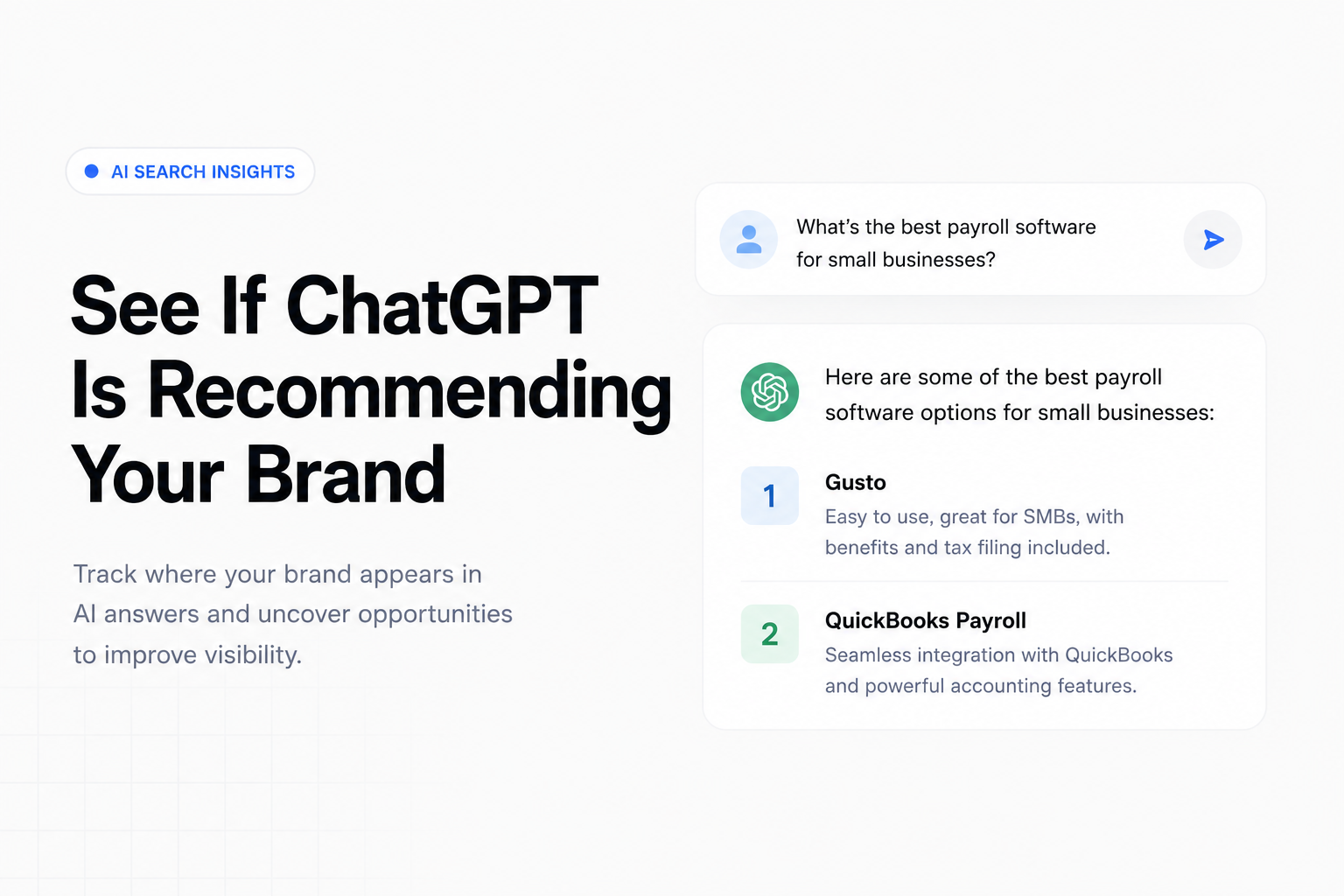
Search isn't dying. But LLMs are changing the way people search.
For the last 15+ years, the playbook was simple to get customers:
- Rank on Google
- Get clicks
- Convert traffic
Instead of typing keywords and clicking through dozens of results, people are asking full questions and getting the top 2-4 results from ChatGPT. Instead of typing short things such as 'best payroll software', they're asking 'What's the best payroll software for X?' And only seeing the top results.
AI has changed how people search. It's training us to type in questions in full sentences when we search for products instead of keywords. And thus, it's changing how brands get discovered.
That removes something most brands relied on: being “one of many options.” Because users used to scroll and scroll through google results. They'd see the first ten options immediately. Now there’s often only one answer, or a short list. And if a brand isn’t in that answer, it effectively doesn’t exist for that query.
In this post we’ll cover
- Why AI answers change how customers discover brands
- Why most teams have no visibility into AI recommendations
- What “AI Search Optimization” actually means
- How to measure whether ChatGPT recommends your brand
- A repeatable workflow to improve where you show up
The uncomfortable reality: most brands have zero visibility into AI. The real problem is this: there’s no built-in way to see if a brand is showing up in AI-generated answers consistently.
Traditional SEO tools won’t help. They track rankings, keywords, and backlinks, but they don’t answer questions like:
- Is the brand being recommended by ChatGPT?
- For which queries does it show up?
- How often is it mentioned vs competitors?
- What trigger those recommendations?
So most teams are operating blind. They’re investing in content, distribution, and SEO… while a completely new layer of discovery is happening with no measurement. Justin Jackson said Transistor trials are 50% from LLMs now. Up from 10-15% a year ago. That's a massive jump. And think about how these buyers are more likely to buy too.
This is where AIO actually becomes real
SEO answers
Where does the brand rank?
AIO answers
Does the brand get recommended at all?
Those are fundamentally different problems. A brand can rank #1 on Google and still not be mentioned in an AI answer right now. And it's sort of a blackbox as to who shows up and why.
Because AI systems don’t just rank pages. They collect tons of information, collapse multiple sources into one answer, prioritize perceived authority and clarity, and select brands that fit the question context. They're not just looking at your page. They're looking at your page, your blog posts, your social media, your reviews, your competitors, and more.
Visibility is no longer about position. It’s just about being included.
What Kelsey is actually solving
Kelsey exists because this visibility gap is massive. Instead of guessing how AI systems treat a brand, Kelsey measures it directly by actually running the queries.
1. Real query tracking across AI answers
Kelsey takes high-intent, customer-like queries and runs them through AI systems. Not keywords. Real questions. Not 'best payroll software'. Real questions that users might ask. And Kelsey runs dozens of them. We rely on fanned out queries to get a more accurate picture of what's happening.
- “What’s the best tool for X?”
- “How do companies solve Y?”
- “What should I use for Z?”
Then Kelsey tracks whether the brand is mentioned, how frequently it appears, where it shows up in the answer, and which competitors are included instead.
That turns something abstract into something measurable. Instead of “AI might mention the brand,” it becomes: “The brand appears in 18% of relevant queries. Competitor A appears in 42%.”
2. Competitor visibility, not just brand visibility
Most tools stop at “the brand is missing.” That’s not enough. Kelsey shows which competitors are consistently recommended, the exact queries they’re winning on, and the contexts where they outperform.
If a competitor is showing up, it’s not random. It’s because their content, positioning, or authority aligns better with how AI systems construct answers. That creates a clear opportunity: reverse-engineer what’s working instead of guessing. Kelsey doesn't guess on what makes a brand show up. We measure it based on actual queries and recommendations.
3. Turning visibility gaps into specific actions
Generic advice is useless here. “Create better content” doesn’t solve anything. Kelsey ties recommendations directly to observed gaps:
- Missing coverage on specific high-intent questions
- Weak positioning in comparison-style queries
- Lack of presence in certain categories or use cases
And it translates those gaps into concrete outputs: what content needs to exist, what topics need to be expanded, and where competitors are setting the standard.
The actual workflow for improving AI visibility
Step 1: Establish a baseline
Run a full scan of relevant queries and understand where the brand appears, where it doesn’t, and how often competitors are included. Most brands start lower than expected.
Step 2: Identify high-impact gaps
Not all gaps matter equally. Focus on high-intent queries, commercial or decision-stage questions, and areas where competitors dominate visibility.
Step 3: Analyze competitor patterns
Look at what competitors are consistently associated with, how they’re described in AI answers, and which categories or use cases they “own.”
Step 4: Align content and positioning
It’s not about producing more content. It’s about producing aligned content—content that directly answers the types of queries AI systems use, clearly positions the brand within a category, and reinforces authority in specific use cases.
Step 5: Continuously measure and iterate
AI visibility is not static. As models update and content changes, recommendations shift. Tracking over time turns this into a system instead of a one-time effort.
FAQ
What is AI Search Optimization (AIO)?
AIO is the process of increasing the likelihood that a brand is included in AI-generated answers. It’s not about ranking pages anymore and showing up in the top ten. It's about showing up in the top 1-3 answers that AI recommends.
Why does AI visibility matter?
Because AI answers are increasingly the final step in discovery. If a brand is included, it’s considered. If it’s not, it’s ignored. You're invisible if you're not in the answer.
How is this different from SEO?
SEO optimizes for placement in search results. AIO optimizes for inclusion.
The bottom line
Either the brand is in the answer. Or it isn’t. Kelsey exists to make that visible, measurable, and fixable.